DIY Farmhouse Wide Plank Flooring Made From Plywood
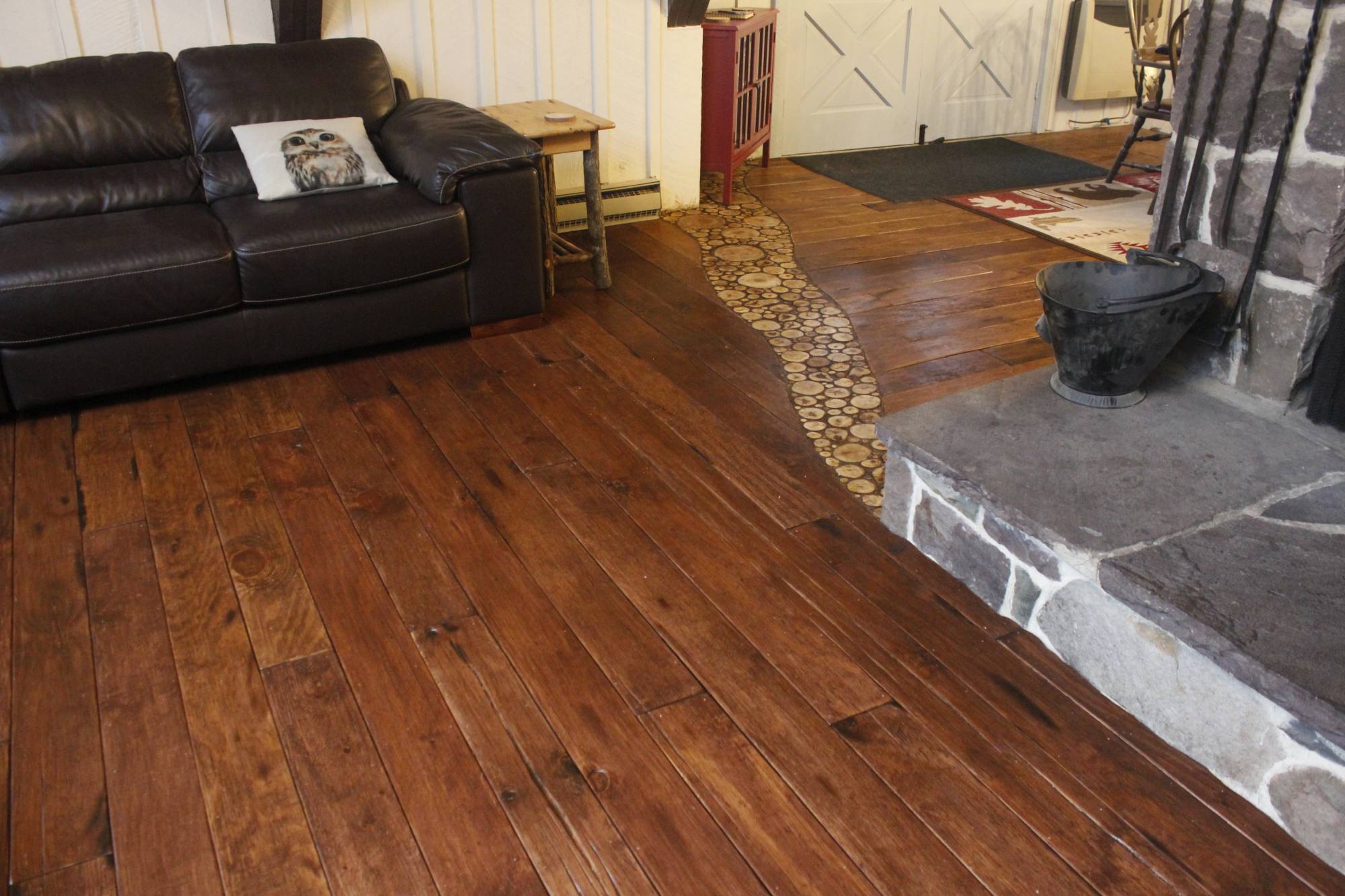
The first farmhouse wide plank flooring made from plywood project we did was in the dining room earlier in the year.
Well, we loved it so much we did the same wide plank flooring in the living room.
For the most part, both the floors were done the same way, with a couple of exceptions. In this article, we’ll go over the differences between the two floors.
Check out the dining room plywood floor article to see more of the step by step details.
As far as time goes, the dining room’s wide plank flooring took about a week to finish and the living room took a lot longer.
The living room is a bit bigger, but what really added time to the project were the shimming and the end grain flooring inlay.
From start to finish, it took a little over two weeks to finish the living room floor.
Disclosure: Some of the links below are affiliate links. If you decide to purchase any of these products, we earn a small commission at no additional cost to you. We recommend these products only because we have experience with them and use them for our own projects. As Amazon Associates, we earn from qualifying purchases.
Update: Several years on, this living room farmhouse floor has held up really well. The two things we changed on this one, the finish routine and the character builder, are still exactly what we would recommend if you are doing your own.
The methods we used for the flooring in the dining room and the living room were pretty much the same.
In the living room, we pulled up the old carpet, removed staples, painted the sub-floor a dark color and put down the floor the same way it was done in the dining room.
The width, length and thickness of the plywood planks was the same, and we cut, sanded, distressed, stained and added 3 coats of polyurethane to the flooring in almost the same way.
There were some small changes we made that saved us a little time and may have added some more character to our DIY plywood plank floor.
Here are the things we did a bit differently this go around.
When we did the dining room floor, we lightly sanded the bumps out of the coat of polyurethane with 120 grit sandpaper.
With the living room floors, we figured that the bumps on the plywood planks would even out a little after multiple coats of poly were applied.
Besides, the bumps would add a bit more texture making the floors less slippery. Not that the dining room floors are slippery – it was just a way of justifying it in my head. 😉
The only concern I had was how it would feel walking barefoot on the floor with more texture.
Turns out, despite clearly feeling the additional texture when running your hand on the plank, it was barely noticeable when walking on it barefoot.
Here’s a list of the tools we used on this project, it’s basically the same list of tools from the dining room flooring project.
Affiliate links below may be to similar items when exact items couldn’t be found online.
Extra Battery For Finish Nailer
These are the supplies used on this project.
Affiliate links below may be to similar items when exact items couldn’t be found online.
Varathane Cherrywood Gel Stain – we used about 7 quarts
Water Based Oil-Modified Poluyrathane – we used 2 gallons
3″ Natural Bristle brush – 6 brushes to apply the stain
4″ Polyester Synthetic Brush – 4 brushes to apply the poly
Masking Paper – We used the masking paper to protect the deck when applying the stain and poly
The same original cast of character builders was used with the plywood planks in the living room. A hammer, pliers, and a propane torch… and this time we added a utility knife to the arsenal.
For the dining room, we would dig into cracks in the wood using the sanders to open the cracks up and soften the edges.
This time we used a utility knife to lengthen and widen the cracks in the wood.
Then we softened the edges of the cracks with the sander.
The result was even better than we imagined.
The deep cracks we made with the utility knife gave us the aged, farmhouse wide plank flooring look we were going for.
You wouldn’t even guess that it was plywood.
The living room floors were much more uneven than the floors in the dining room.
To the point where we needed to add shims in the low spots to try and level things off a little.
I went around the floor with a straight edge, and where ever there was a dip, I added shims.
Since I knew I needed a good amount of shims, I made them out of a sheet of 1/4″ plywood. I ripped the sheet into 1″ strips using the table saw.
Once the floor was shimmed, we painted the floor a dark brown color, just like we did in the dining room.
[et_bloom_inline optin_id=”optin_7″]
Like I said, the living room floor took much longer to do than the dining room floor did. It took a little over two weeks to finish, had I not messed up with the wood slice accent flooring, we would have finished in about 2 weeks.
Check out the wood slice accent flooring project here
We love the farmhouse wide plank flooring in both the dining room and the living room. This style was the perfect fit for this house, we couldn’t have imagined a better fit.
Between the two floors, I’d say I’d stick to the steps used on the living room floor.
Sanding between poly coats seems to have been unnecessary, and using the utility knife to expand on the cracks in the wood added sooo much more character to the living room floor – LOVE IT!
Here are a few more pictures of the stained plywood floors on the living room floor.
Let me know what you think, is there something you would have done differently? Are you thinking of doing DIY plywood floors in your home?
Share your thoughts in the comments below!
The Amazon affiliate tracking id replacer tool updates the tracking id in your Amazon Affiliate…
There are already wainscoting calculators out there but they're too complicated. This wainscoting calculator uses…
In this post we’ll go over how to paint laminate cabinets. We did this project…
Let me first say that converting a box spring into a platform bed is not…




View Comments
Bonjour !
Je veux faire ce projet de plancher en Plywood sur de la céramique. Comment dois-je fixer les lattes de plywood sur les carreaux de céramique ? Est-ce possible de visser le plywood dans les joints de céramique ? Les carreaux déjà là sont très bons et bien fixes. Si non, je devrai coller le plywood, quelle colle utiliser ? Merci beaucoup pur les infos. Vos planches sont magnifiques !
Bonjour Charles!
Wow, gluing the plywood planks on ceramic tile... my first reaction is yikes. lol
But after thinking about it a little, I guess it would work. You would just need to make sure you have a good space between each plank because each one is going to expand and contract and the ceramic will not. Without enough space between each plank they'll start pushing against each other and buckle or pop off.
The other thing I'd think of is moisture. If the area you're installing the flooring in doesn't have moisture, like it's not in a basement then I think you'd be good to go.
As far as which glue to use. It would need to be something strong, flexible and able to stick to the ceramic but not impossible to remove - in case you ever want to change the floor. Off the top of my head Liquid nails would be my go to because it glues anything to anything - so that would work, but it would make removal of that floor absolutely painful. lol
I really can't think of anything better than liquid nails to keep the planks in place. Just keep in mind removing that floor may be a challenging task if ever you want to change out the floor.
What color stain did you use?
Hi Pamela, we used cherrywood gel stain from Varathane, you can find it at Home Depot. If you want more details about what we used and how we did the planks, take a look at this post:
https://ourprojectideas.com/diy-rustic-wide-plank-plywood-flooring/
That post goes into a whole lot of detail about the process we used. :)
Your floors are stunning! I love the way they came out. I am wanting to try this in my home, but I was wondering how did the floors hold up over time? Did the floors delaminate or buckle?
Hi Katie! Thank you so much. :)
There hasn't been any delaminating or buckling - thank goodness!! LOL
They've held up amazingly. There have been scratches in the surface but that all adds to the wabi sabi (perfectly imperfect) I was looking for.
You did an outstanding job!!! Just asking for your opinion. I plan on doing something similar. You mentioned placing your planks directly on your subfloor without a vapor barrier. I live in a Mobile home and I put in laminate flooring ( the cheap kind I guess) because it’s terrible now I did put in an “expensive” barrier. A mobile home is off the ground 3 feet. Do you think I need the barrier.
Hi Melissa! Hmmm, I wouldn't think you would need a vapor barrier unless you're installing it on concrete, where the moisture can seep in through the concrete and affect your flooring. From the sounds of it that is definitely not an issue in your case. In your shoes I would install it directly on the subfloor.😊